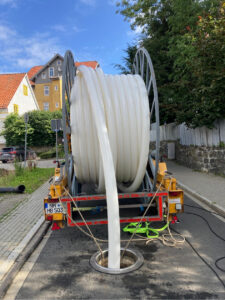
Sustainability in the supply chain is an important decision criterion for municipalities, utilities, and grid operators. Overall, plastic pipes have a very good environmental balance, especially when compared to other materials. An overview of recycling, bio-based materials, and Environmental Product Declarations (EPDs) that evaluate the entire product life cycle.
In many areas, such as water supply, wastewater disposal, or construction, plastic pipes are indispensable today. Nevertheless, they are at the center of sustainability discussions due to their fossil origin and potential environmental impact. Yet, even today, plastic pipes are more sustainable than their reputation suggests.

©istockphoto.com_Vadimborkin

| © envato.com / Anna Ostanina |
Recycling in Plastic Pipe Manufacturing
egeplast primarily processes the thermoplastic polyethylene and recycles 100% of the internal scrap generated during the start-up and shut-down of production lines. In this way, every gram of plastic eventually becomes a pipe and no material is wasted.
The proportion of purchased recycled materials is low because – due to the very long service life of plastic pipes – there are simply few returns. Plastic pipes fulfill their purpose over a very long period, and there is no
reason to replace these pipes.
In principle, thermoplastic plastic recyclates available on the market can be fed into the processing procedure and processed into new pipes without any problems. However, the quality of these recycled materials cannot be compared with that of the materials originally used. Therefore, recycled materials are not used today for pressure pipes or even drinking water pipes, but are only used in the areas of gravity-fed wastewater disposal, rainwater management, and cable protection.
Existing Approaches to Recycling
There are currently various methods for recycling plastics:
Post-Consumer Recyclates (PCR):
Reuse of plastics from household waste (e.g., from packaging) in pipe production
Post-Industrial Recyclates (PIR):
Use of industrial waste, e.g., production residues from own manufacturing
Multilayer structures:
Use of recyclate in the core of the pipes, while the outer layer consists of virgin material (for hygienic or technical requirements)
A distinction is made here between chemical and physical recycling.
In chemical recycling, the polymers are broken down into
their basic chemical building blocks at the molecular level.
After decomposition, these can then be used again to manufacture new plastics that have the quality of virgin material. Unfortunately, chemical recycling is very energy- and cost-intensive.
In contrast, the chemical structure remains unaffected during physical recycling.
In this form of recycling, plastics are shredded and then reprocessed so that new pipes can be extruded from this material in the future. egeplast uses mechanical recycling of its own post-industrial recyclates to meet its ecological responsibility and work in a more resource-efficient manner.
Focus on Sustainability
Furthermore, there are approaches to manufacture the base material for our pipes, polyethylene, not from fossil raw materials but from renewable raw materials. These so-called bio-based plastics can exhibit the same properties as fossil-based materials but are lower in CO2 during their production. The limiting factor here is the limited availability of renewable raw materials, which also has a significant impact on the price of the materials.
Since bio-based plastics, which differ from fossil-based materials only in their origin but not their quality, are only available to a limited extent, mass-balance approaches have become established so that a manufacturer can document exactly which customer receives which raw material:
With the help of the mass balance system, the amount of sustainable raw material used is tracked for accounting purposes. A portion of the polymers produced from this may be declared as “ISCC PLUS certified” – corresponding to the proportion of sustainable raw materials used.
The end product is not physically labeled; instead, the sustainable portion is mathematically distributed using the mass balance system. This allows sustainable raw materials to be used without requiring an adjustment to the production process. The certified portion is documented to enable verifiable and transparent sustainability communication towards customers.
More Transparency Thanks to EPDs
How sustainable various construction products are can depend heavily on manufacturing as well as the raw material. Is green energy used? Are there closed loops for cooling water, etc.? These aspects can be objectively compared using environmental labels such as EPDs.
In contrast to other certifications, the sustainability values of EPDs are not based solely on production but refer to the entire product life cycle of a product. This standardized procedure allows the end customer to make an easy comparison in order to also take sustainability into account during decision-making.

Source: Sustainability