


The HDD method has gained increasing importance in recent years and will continue to move into focus in the future. Dr.-Ing. Thorsten Späth, Head of egeplast Product Management, spoke with Marc Schnau, Vice President of the DCA, about this environmentally friendly installation method.
Mr. Schnau, in addition to working in your own engineering office, you are active in the Verband Güteschutz Horizontalbohrungen e. V. (DCA) and are currently Vice President. What does the DCA association advocate for?
The aim of the association is to maintain, promote, and further develop the technical standard of horizontal directional drilling at a European level. In addition, the framework conditions for the use of this method are to be improved.
Furthermore, the association provides an international forum that enables a constant exchange of experience between HDD contractors, suppliers, Design Engineers, customers, and authorities.
Which challenges are currently influencing the industry?
For several years, demand from high and extra-high voltage cable projects has dominated the HDD sector. Both clients and HDD contractors have had to, and still must, develop a mutual understanding of requirements, possibilities, and limits of application. This process is not yet complete and will continue for some time, as personnel resources are being increased on both the client and contractor sides—often involving career changers in HDD technology who must also be integrated into this process.
Which requirements have influenced the HDD method in recent years and driven its development?
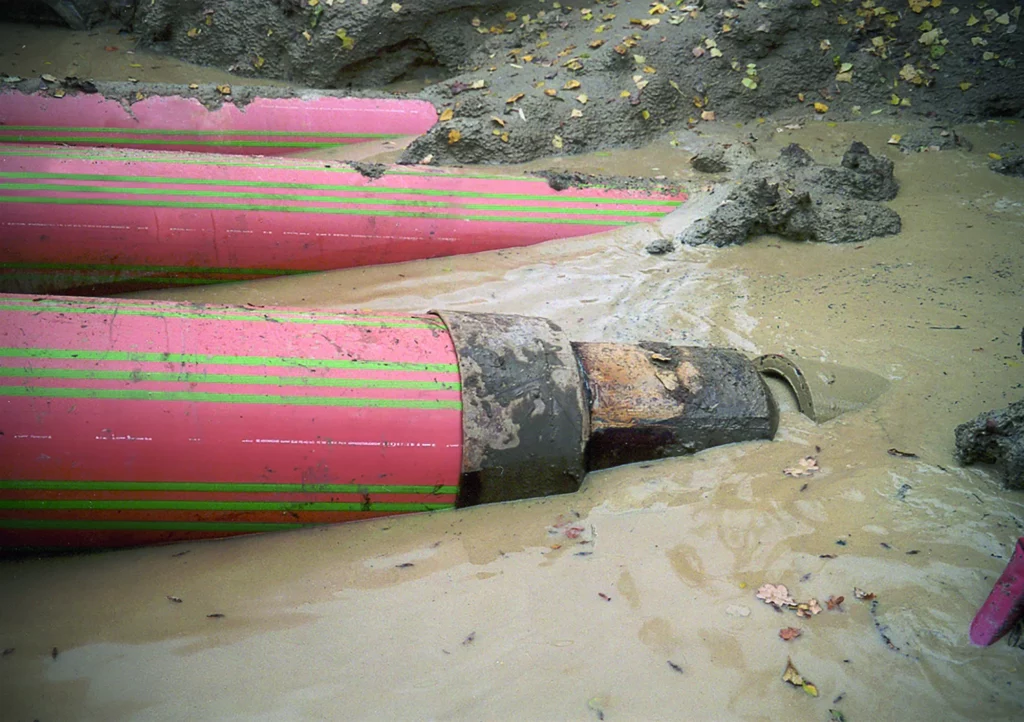
First and foremost, the higher requirements for drilling accuracy in cable projects should be mentioned. Many of the drillings required for these projects involve so-called “small-scale drilling technology.” Here, horizontal drillings with lengths of up to approx. 400 m must be carried out using drilling rigs with up to 400 kN pulling force. In this segment, the use of walk-over tracking methods without special accuracy requirements for the installation of HDPE cable protection or product pipes was previously common. However, since high and extra-high voltage cable projects usually require several parallel HDD drillings (sometimes up to 14 units) and cable spacing and depths are decisive criteria for ensuring the calculated heat dissipation during later cable operation, they are subject to special accuracy requirements. For this reason, wireline drilling measurement systems are used much more frequently in small-scale drilling technology than in the past. The expertise built up by all parties involved is now, of course, also benefiting other projects outside of high and extra-high voltage cable laying. Accordingly, the DCA dedicated its annual members’ forum in May 2023 to the topic of drilling accuracy.
The high demand mentioned in the previous points naturally leads to a steadily growing inventory of pipes laid using the HDD method. Consequently, professional as-built documentation plays a very important role in providing a reliable basis for determining available construction space for future construction projects. In addition to documenting the as-built position, documentation of the construction execution in the form of daily reports, drilling, and flushing logs is also important. Modern drilling rigs now offer systems for automatic drilling data acquisition. To channel the variety of information that can be recorded here, the DCA has also founded a working group to develop corresponding specifications as recommendations.

How does the possibility of laying pipes using the HDD method contribute sustainably to environmental protection?
The HDD method is an environmentally friendly installation alternative, as intervention in sensitive natural areas can be avoided or minimized. This is particularly evident in the landing of offshore wind farm connection cables in the North Sea. . But natural areas are also protected onshore on various energy routes to be created by using the HDD method for trenchless undercrossing.
National capacities do not seem to be sufficient for the upcoming projects in the market. Do you consider foreign companies, whose qualifications may not be sufficient, to be a risk?
This is indeed a major topic in the market. The capacities currently available in Germany will not be sufficient to meet demand. As a result, several foreign HDD companies can already be seen on projects in Germany. As the DCA, we see a risk here that the quality standard built up over years in Germany—including the certification of HDD companies according to DVGW worksheet GW 302—could be undermined. In view of ongoing Europeanization, however, national regulations and associated certifications will lose importance anyway. Both the DCA and other associations are working on measures to internationalize national regulations and to make qualification measures, such as specialist staff training in English, accessible to foreign companies. In general, the training of specialist personnel is becoming even more important because, as already mentioned, resources are being built up and numerous career changers must enter the HDD industry.

What additional or better properties could future pipe systems desirably have?
HDPE plastic pipes offer high flexibility, but reach their limits with tensile strength in long horizontal drillings. At the moment, drilling lengths on cable projects are still limited by the cable lengths currently available. Should the possibility for longer cables arise over time, corresponding HDPE pipes with sufficient tensile strength would, of course, be desirable.
Furthermore, it is not always possible to prefabricate a pipe string for pulling into an HDD borehole over its entire length if the working space behind the horizontal drilling is not sufficient. Prefabrication of partial strings and welding of the partial strings during pipe pulling is possible, but is associated with a corresponding downtime in pulling and the fact that the internal bead of the connection weld cannot be removed. This represents a potential obstacle or risk for subsequent cable pulling. Here, it would be desirable to have a pipe connection technology available that can be produced quickly and does not require an increase in internal and external wall thickness. Especially for landing drillings, such a technology could also enable the welding of individual pipes, double or triple lengths, etc., on a pontoon during pulling into the borehole, thus making the complex floating and positioning of the entire pipe string unnecessary. The egeplast Smart-Connect system is already moving in this direction. The pipe connection must be able to exhibit the same strength properties as the base pipe.

Author Information
Marc Schnau is the owner of the engineering office x-plan schnau engineering GmbH & Co. KG, which offers planning and consulting services in the field of trenchless pipe laying, and specifically Horizontal Directional Drilling (HDD). His clientele includes national and international network operators, route planners, and contractors. As a publicly appointed and sworn expert for Horizontal Directional Drilling (HDD) and related methods, he also works for courts and insurance companies. On behalf of DVGW Cert GmbH, he carries out company audits as part of certifications according to DVGW worksheet GW302. He is a long-standing board member and current Vice President of the DCA.
Source: Sustainability
