


PE pipe systems have been in use for 70 years. Experience shows that suitable pipe systems made of PE material can be operated reliably and economically for many decades within their operating limits when properly installed and assembled.

Trenchless installation techniques offer cost reduction potential.
Trenchless installation techniques offer economic and ecological advantages
The reasons why subsequent access to finally installed pipelines is problematic are obvious:
- Valuable sealed surfaces are created.
- Enormous costs arise in the event of later damage.
- Diverting traffic or closing roads is hardly enforceable given today’s traffic density.
Due to cost relationships in civil engineering, alternative trenchless installation techniques become additionally economically attractive. The pipe price rarely accounts for more than 15 percent; total costs are determined 85 percent or more by civil engineering and surface restoration. By using trenchless installation techniques, considerable cost reduction potential opens up. The material-specific advantages of PE pipes (flexibility, low weight, long lengths, small excavation pits, etc.) come fully into play. Decisive for material selection is the chosen installation method and accordingly the risk of damage to the pipe systems used.

100 Years Service Life
Underground infrastructures are created with considerable civil engineering effort. Therefore, it is the goal of every operator to be able to operate a new pipeline as long as possible without damage. Pipes made of polyethylene offer a service life of at least 100 years when properly installed. However, if they are damaged during installation, this long service life can be significantly shortened. The cause of this can be damage or weakening of the pipe wall during installation. Since the standardized wall thickness is precisely matched – albeit extended by the safety factor – to the operating pressure, any weakening means a reduction of the engineering safety factor or, in the case of significant damage, even a direct reduction of the pressure resistance of the new pipeline and thus a shortening of the service life.
Additive protective layer for damage-free installation
With installation techniques in open construction without sand bedding, point loads from stones or shards pressing on the pipe wall are to be expected. The use of polyethylene pipes made of RC materials with integrated protective layers and highest resistance to slow crack propagation is essential for this type of installation. This pipe construction does not have notch protection, regardless of whether the pipe wall is constructed in one, two, or three layers.
Trenchless installation techniques place particular demands on the pipes to be installed. During new installation or renovation of old pipes, grooves and notches in the pipe cannot be avoided. For black-box methods, pipes with additive protective layers are therefore required to ensure damage-free installation and operation of the pipeline.
Proof of non-damage
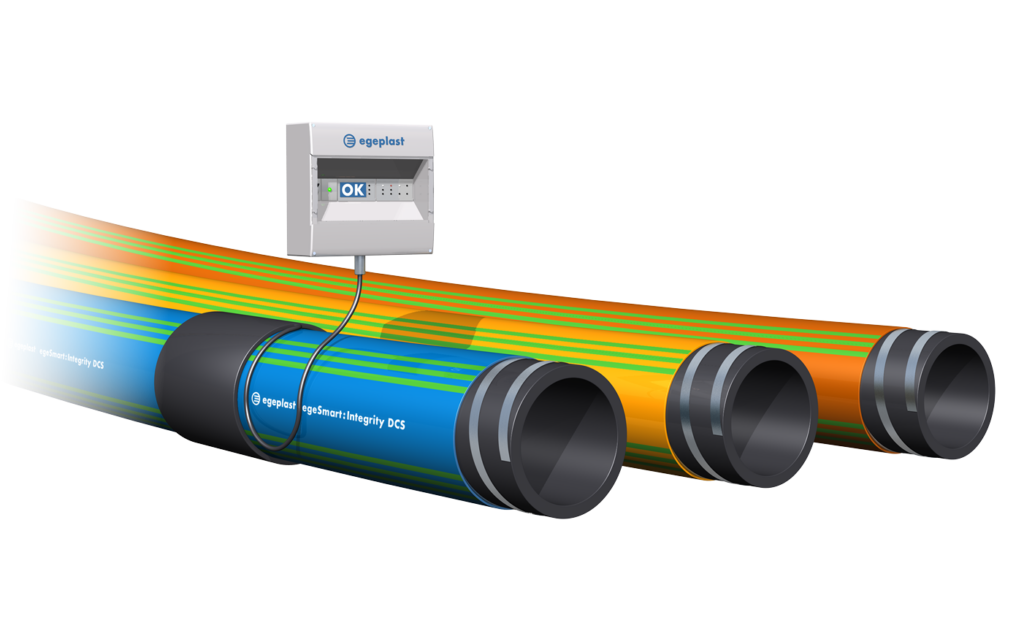
The regulations for trenchless installation methods require complete documentation of all relevant processes of the construction measure. The valid regulations of the German Technical and Scientific Association for Gas and Water (DVGW) recommend intensive incoming goods inspection of the pipeline and pipeline components before open and trenchless installation. Particularly in the case of trenchless installation, it is recommended to visually inspect the exposed parts of the newly installed pipeline section for impermissible damage before the pressure test. The non-visible pipeline parts (black box) remain uninspected. Proof of non-damage is thus not possible. Pipes with integrated conductor bands for construction acceptance offer the possibility of quality verification and close this inspection gap.

egeplast
egeSmart:Integrity DCS
Early warning system for monitoring critical infrastructure
Pipe location
Manual damage localization
SMS signal
Permanent or discontinuous monitoring
 Learn more
Core pipe made of PE 100-RC / standard dimension
Electrical conductor bands for damage location and function monitoring
Additive protective layer made of PEplus
Figure: left: Undamaged pipe surface after peeling off the protective jacket / right: Scratched pipe surface increases the risk of faulty welding

When using pipe systems with integrated conductor bands, permanent monitoring of the pipeline during operation is also possible, which offers further advantages.
With pipeline systems with integrated conductor bands,
1. Design Engineers can document that they have selected the correct pipes for the installation method and have provided defect-free contractual performance. In the event of later damage, they can refer to this.
2. the installer can preventively demonstrate and document during acceptance that they have installed the pipes without damage. The final acceptance confirms to the customer the perfect condition of the pipeline. In the event of any later damage, they can refer to this.
3. the grid operator can preventively document that the pipeline systems were undamaged at the time of completion. It is therefore logical that a grid operator would require proof of undamaged installation upon acceptance using pipes with conductor bands in the tender.
4. the grid operator can also use the conductor bands for permanent monitoring of the pipeline during operation and receives complete documentation of trouble-free operation. The intelligent early warning system sounds an alarm immediately even in the event of the slightest damage. The damage can be remedied quickly and cost-effectively, as civil engineering costs are minimized due to fast and meter-precise location.

