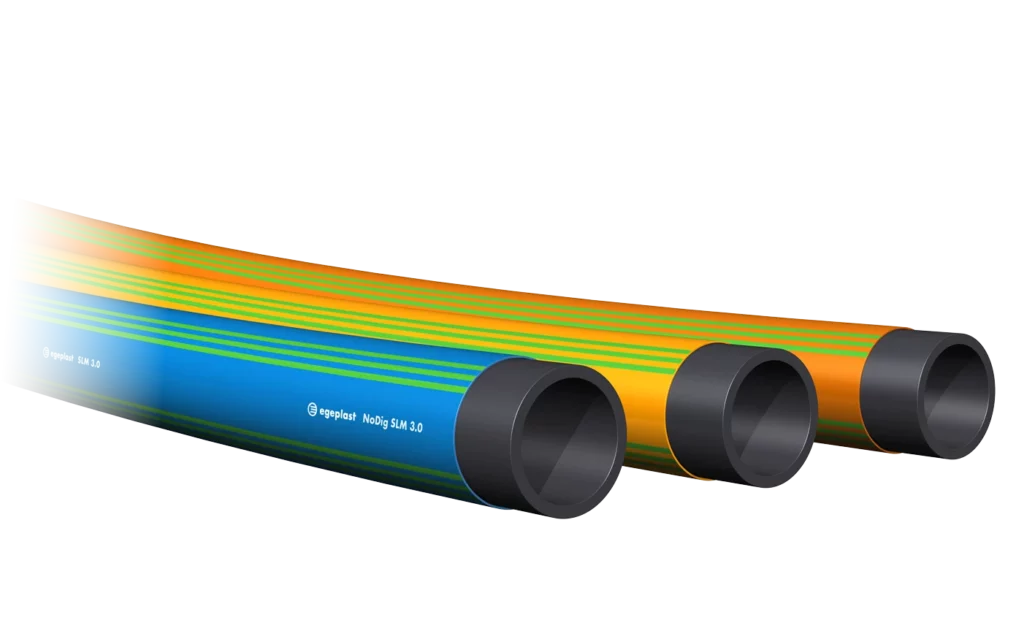
Using controlled plow installation, the company IFK has performed trenchless installation of numerous drinking water and wastewater pipes in the Czech Republic. Tight space conditions and gradient specifications required high precision during installation as well as compliance with ÖNORM EN 12889. This was achieved using the controlled plow installation of NoDig SLM® 3.0 protective-layer pipes – at a significantly higher installation speed than with open trench installation.

Pioneering installation method
In a whole series of specialized civil engineering projects, the company IFK GmbH has performed trenchless installation of NoDig SLM® 3.0 protective-layer pipes using controlled plow installation – all in the vicinity of Prague. The clients required compliance with ÖNORM EN 12889 “Trenchless installation and testing of wastewater lines and sewers”. This standard describes the electronic measurement and precise documentation of the position of the installed pipeline. In the controlled plowing process, all planning data is imported digitally into the plow computer. This allowed the position and depth of the new line to be monitored and documented. The general contractors were VCES a.s. for the “Jizery Part A” project, POHL cz, a.s. for the “Jizery Part C” project, and TB BUILDING s.r.o. for the “Choustník-Bohemian Chips” project. Commercial and logistical processing was handled by Gerex Liberec, s.r.o., the egeplast sales partner in the Czech Republic.

Significantly higher installation speed
The NoDig SLM® 3.0 protective-layer pipes were supplied in dimensions OD 110 mm, OD 180 mm, and OD 225 mm – up to OD 180 mm as coiled goods, and in OD 225 mm as rod goods. Prior to the plow installation, the pipes had to be laid out along the route and welded using electrofusion couplers. The NoDig SLM® 3.0 drinking water pipes for the “Choustnik – Bohemian Chips” construction project, which were delivered as rod goods, were joined together using the heated tool butt welding process. After this step, the pipe ends were inserted into the feed device of the plowing equipment. Using coordinates read from the planning documents and imported into the plow computer, the lines could be installed with very high precision in terms of both position and height. This ensured that the correct position and a continuous gradient between the planned high points (vents) and low points (outlets) were maintained.
In addition, the current coordinates were documented every second, so that the actual position could finally be represented in the technical plans. This is an important component of the construction site measurement and the plan handover. Thanks to the coordinate-controlled plow installation, it was also possible to lay two pipe strings side-by-side at a precisely defined distance in several route sections of the “Jizery Part A” project. A good comparison of the space requirements and the speed of installation was provided by the sections that had to be realized using conventional open trench construction. With open trench installation, an average of approx. 50 m per day was achieved: the pipe trench was excavated, the line was laid in the trench, measured, and finally backfilled and the surface restored. With the controlled plowing process, an average of approx. 1,000 m per day could be installed and measured. The working width for plow installation was a maximum of 4 m – in contrast to at least 10 m for open trench installation.

Protective-layer pipes offer safety
With regard to processing and installation requirements, the NoDig SLM® 3.0 protective-layer pipe was the right choice. Since it was also delivered as coiled goods for a pipe diameter of OD 180 mm, it could be laid out and welded in a very short period of time. Furthermore, this minimized the number of connection points. The controlled installation of the NoDig SLM® 3.0 protective-layer pipes was completed to the full satisfaction of the customer – in compliance with both time and quality specifications.
egeplast
NoDig SLM® 3.0
Protective layer pipe system for damage-free installation
Additive protective layer made of PEplus
Core pipe made of PE 100-RC