
Digitalization and AI will only reach their full potential with resilient energy, cooling, and data networks. In modern data centers, monitored pipe systems can detect changes in the pipelines at an early stage. This turns the cooling backbone in the data center into an intelligent monitoring and early warning system.
Cooling is essential for operation
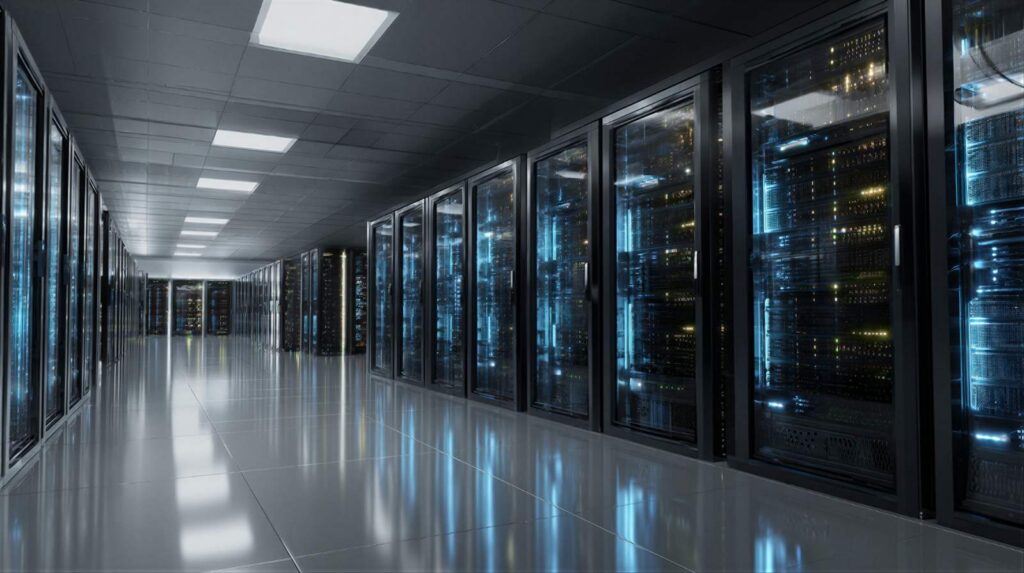
Data centers continuously generate heat that must be reliably dissipated. Efficient cooling is therefore one of the central technical requirements of data center infrastructure. Figures from the Uptime Institute illustrate the economic impact that operational disruptions can have: for 57 percent of the operators surveyed, the most recent major outage caused costs exceeding $100,000. Every fifth major outage even cost more than one million US dollars. These figures highlight the high operational and economic importance of reliable operation. [1]
The cooling backbone connects the cooling infrastructure
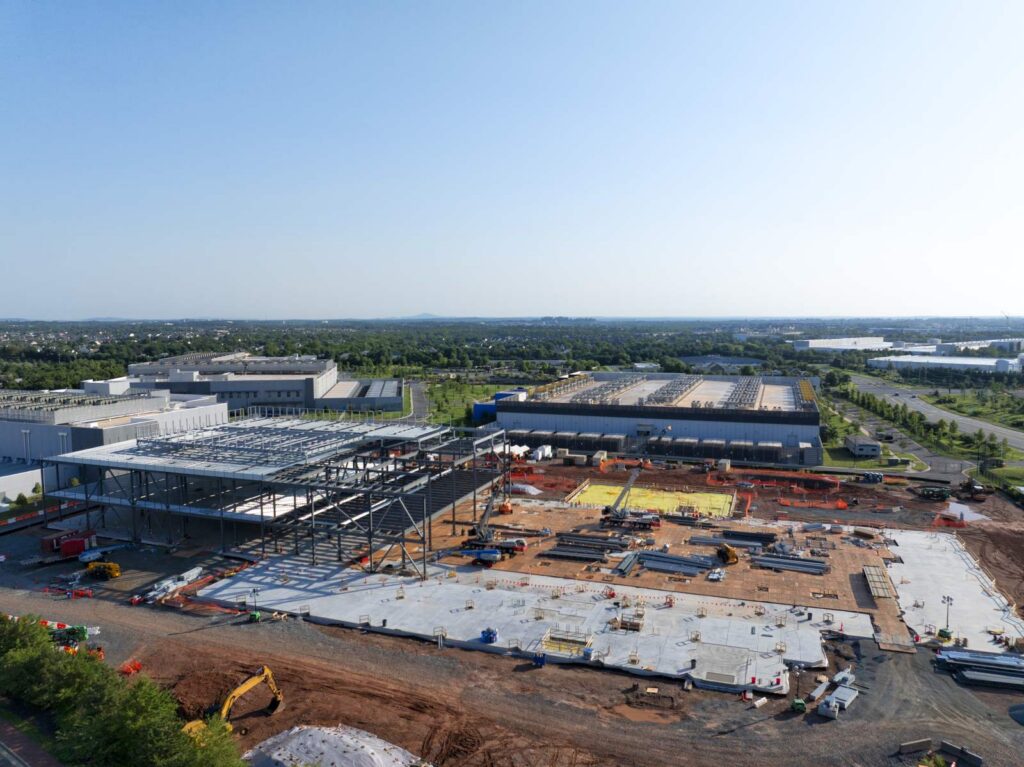
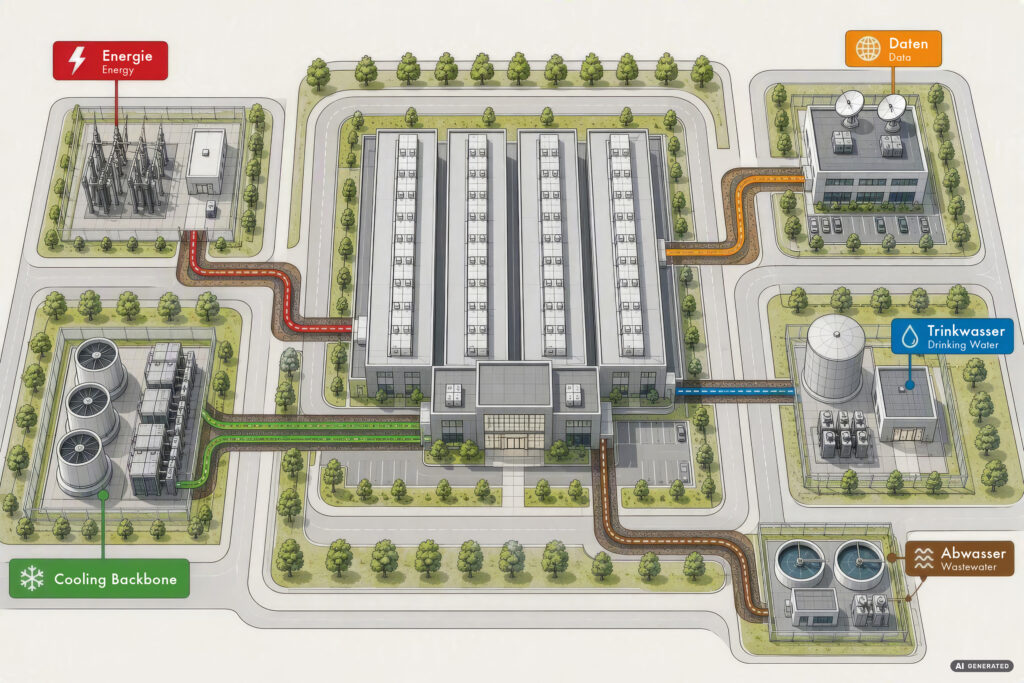
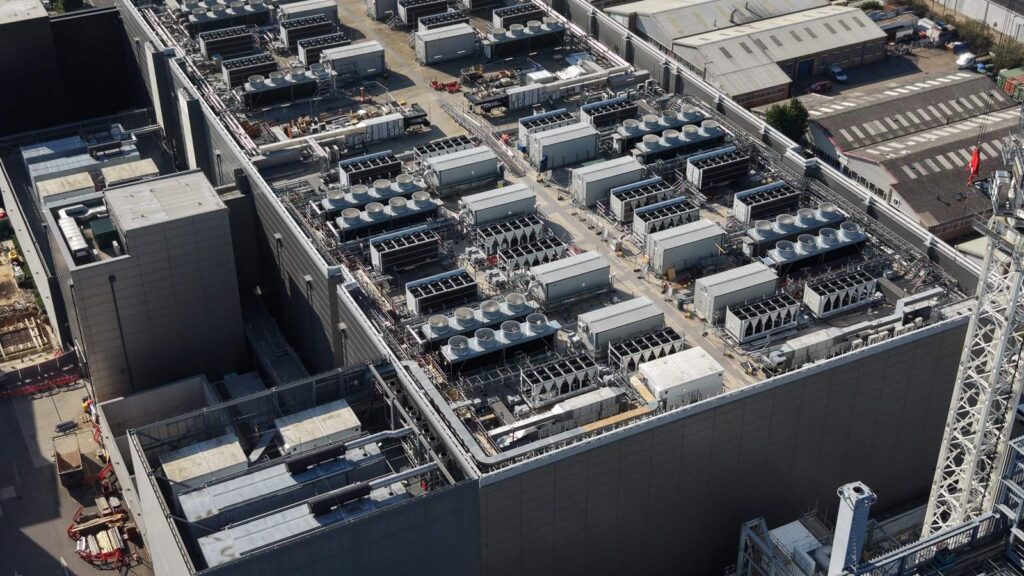
A key part of the cooling system is the external cooling water circuit, often referred to as the cooling backbone. It connects the data center to cooling towers, dry coolers, or chiller systems via supply and return pipes. These pipes can run in large dimensions over long distances and are often buried underground outside the buildings.
PE pipe systems from egeplast are used for this purpose. They are corrosion-resistant and enable longitudinally force-locked, secure welded connections. Smooth inner surfaces promote low pressure losses and thus efficient transport of the cooling water. In addition, large pipe dimensions and various installation methods allow for adaptation to different project requirements as needed. With bends, branches, and flange connections, a complete pipe system is also available that can be implemented consistently and with homogeneous material from corrosion-resistant polyethylene.
These properties form the basis for safe and reliable coolant transport. Since cooling water infrastructure plays a central role in the reliability of data centers, additional monitoring functions can provide further value.
Critical infrastructure underground
The cooling backbone often runs beneath roads, paved operational areas, or other hard-to-access locations. During operation, the pipeline itself is barely visible. Damage caused by construction work or deliberate interference with the route can therefore initially go unnoticed.
Damage to the cooling water pipeline can significantly impair available cooling capacity and have far-reaching operational consequences. In an unmonitored pipeline, smaller leaks in particular may only become visible through escaping water, pressure changes, or operational restrictions. If they remain undetected for longer, the damage and water loss can increase.
Under sealed or operationally used surfaces, locating the issue requires additional effort and can delay repairs. What matters, therefore, is not only that damage is detected, but how early it is recognized and how quickly it is located.
Monitored pipe systems in the cooling backbone
✓ Permanent monitoring
Leaks and relevant changes are detected at an early stage.
✓ Early warning function
External impacts are made visible before water leakage occurs, wherever possible.
✓ Metre-accurate localization
The affected section of pipeline can be precisely determined.
✓ Targeted repair
Search efforts, excavation, and repair are concentrated on the damaged section.
✓ Lower follow-up costs
Shorter response and repair times can reduce limitations to cooling performance and the associated costs.
Monitoring provides a decisive information advantage
Monitored pipe systems create transparency along the buried route. Integrated sensor and monitoring technology detects leaks as well as relevant changes and impacts on the pipeline at an early stage. This expands the cooling backbone from a pure transport medium into an intelligent monitoring and early warning system.
Permanent monitoring reveals anomalies before their effects become apparent at the surface or in operation. In the event of external impact, the system provides an early warning. This allows measures to be taken before the carrier pipe is damaged, cooling water escapes, or cooling capacity is affected.
If damage or a leak has already occurred, its position can be located to the nearest meter. This avoids extensive search efforts along the route. Excavation and repair can be focused precisely on the affected location.
This gain in information and time delivers a direct operational and economic benefit: the faster an event is detected and located, the more targeted the response can be. Search and repair times are shortened, potential restrictions to cooling capacity are limited, and the costs associated with the event are significantly reduced.
From PE pressure pipe to monitored system
egeplast offers complementary pipe systems for the cooling backbone with different levels of functionality.
egelen® serves as the PE pressure pipe that transports the cooling water. Thanks to the polyethylene material, the pipe system features smooth inner surfaces, corrosion resistance, and good conditions for longitudinally force-locked welded connections. It is also available in large dimensions and as a complete system.
egeSmart:Integrity DCS is a PE pipe system with extended functionality. Permanent leak monitoring along with an early warning and localization function make it possible to detect external impacts and damage at an early stage. The damage can then be pinpointed to the nearest meter using standardized localization technology. This gives operators a concrete basis for targeted excavation and repair.
egeSmart:Data uses fiber-optic sensor technology and digital data transmission for continuous pipeline monitoring. The system detects anomalies along the route and indicates their exact position directly. At the same time, both the temperature of the transported medium and temperature profiles along the pipeline can be recorded. The resulting condition and operating data can be documented and integrated into higher-level systems. This creates an ongoing data basis for monitoring the cooling water infrastructure.
Source:
[1] DONNELLAN, Douglas; LAWRENCE, Andy; WEINSCHENK, Rose: Annual outage analysis 2026: The causes and impacts of IT and data center outages. UII Keynote Report 201. Uptime Institute Intelligence, May 2026 [online].