



Material recycling has been established in the plastic pipe industry for 30 years. However, one must look closely at which materials and applications are possible. Regarding pipe products made from recyclates, there is often a lack of not only acceptance but also availability. Furthermore, there are various applications where, according to standards and regulations, the use of recyclates is not permitted. Primary examples include drinking water and pressure applications. Markus Hartmann, Managing Director of the Plastic Pipe Association (KRV), has examined the background in depth and answered our questions in an expert interview:
Mr. Hartmann, the finite nature of resources dictates that they must be handled with care. The coalition government wants to reduce primary raw material consumption – such as crude oil – and create closed-loop material cycles. Are plastic pipes sustainable?
Plastic pipes are long-term capital goods, have a proven service life of over 100 years, and can be recycled at the end of their useful life. These aspects alone demonstrate their sustainability. Throughout their entire period of use, pipeline networks made of plastic pipe systems remain stable, functional, and permanently leak-proof.
What is the plastic pipe industry already doing today to recycle raw materials?
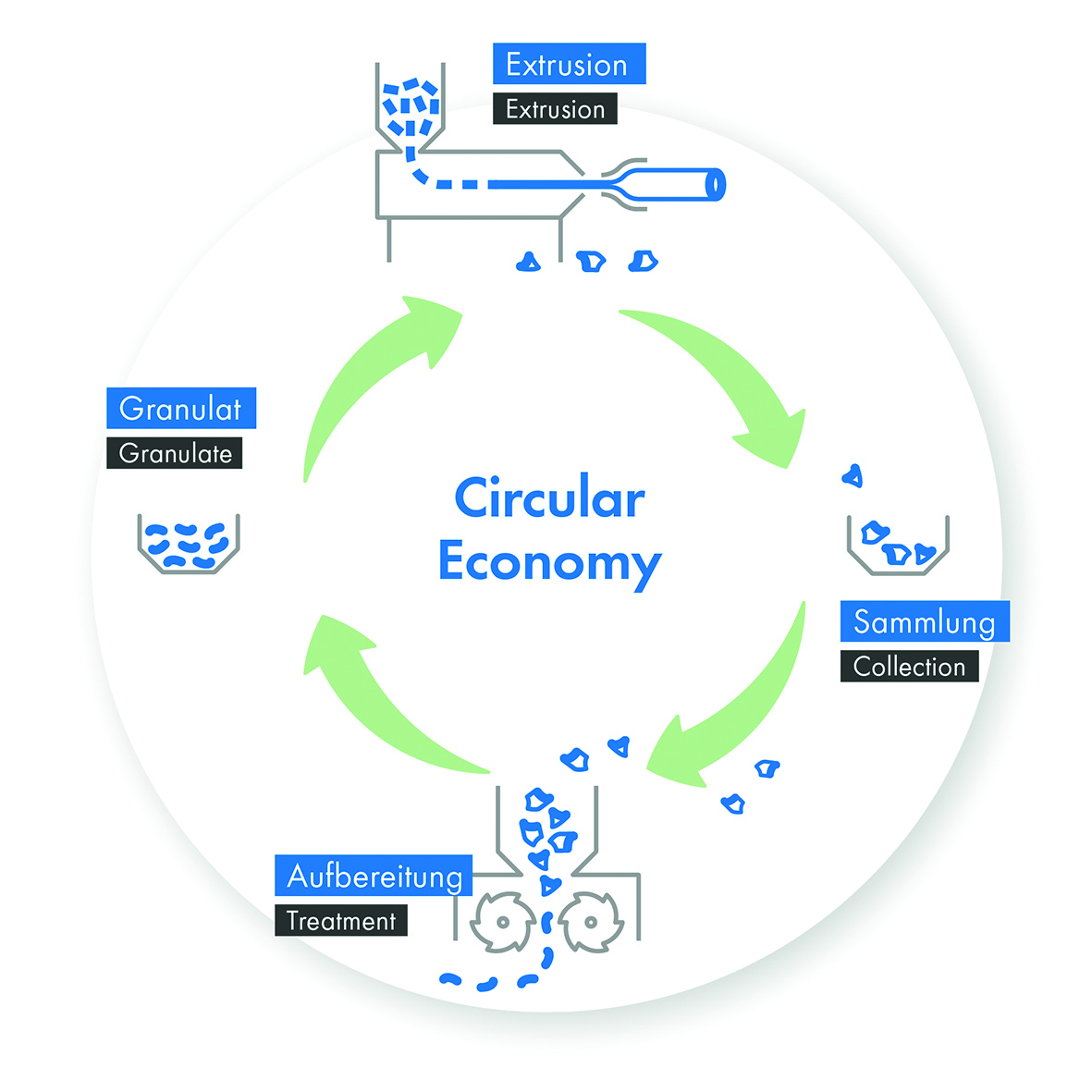
The plastic pipe industry has been building a functioning infrastructure for the circular economy since the 1990s. In principle, thermoplastics such as polyethylene are excellently suited for reuse. They can be mechanically shredded and melted down again.
However, the prerequisite is sorted and clean collection and processing. These processes are complex and challenging.

At egeplast, we mainly process the thermoplastic polyethylene and recycle 100 percent of the by-products generated in-house. In this way, every gram of plastic ultimately becomes a pipe – and no material is wasted. Why is it that, in general, more recycled material from the market is not being used?
Due to the very long service life of plastic pipes, there is correspondingly little return flow. The pipes, some of which have been in use for many years, still fulfill their purpose, and there is no reason to replace them. Furthermore, high-quality recyclates from former pipes are also very popular for other applications and are used in products other than plastic pipes. In principle, thermoplastic recyclates available on the market can be fed into the processing procedure and processed into new pipes without any problems.
In which applications is a circular economy already being successfully practiced today?
A variety of uses can also be found today for pipes made from recycled materials, taking existing quality standards into account. These are particularly in the areas of wastewater disposal, rainwater management, and cable protection. For example, in the case of standardized solid-wall pipes and fittings used for the construction of non-pressure sewers, 10 to 15 percent recyclate may be added. In the case of multi-layer pipe wall structures, the middle layer can even consist of up to 100 percent recyclates. All plastic pipes are durable capital goods characterized by chemical resistance, corrosion resistance, pressure resistance, and static load-bearing capacity. Due to their excellent material properties, they ensure the highest drinking water quality and the safe transport of gas through our gas networks. In the field of drinking water and gas supply, exclusively virgin material is used for reasons of hygiene, health protection, safety, and environmental protection – corresponding details are laid down in standards and technical regulations.

When laying fiber optic cables, network operators can rely on a product line from egeplast that consists of up to 100 percent high-quality recyclates. What is necessary to increase the acceptance of products made from recyclates?
Public clients could, for example, lead by example in their project tenders and prefer sustainable product solutions over conventional alternatives. Last year, the Federal Ministry for Economic Affairs and Climate Action (BMWK) conducted a stakeholder process on the topic of “Green Lead Markets,” in which we actively participated as the KRV. In parallel, the procurement law for public procurement is currently being revised, and a ministerial draft is expected in the second quarter of 2024. As the Plastic Pipe Association, we have developed a corresponding position paper on the entire subject and submitted it to political decision-makers.

Source: Sustainability
