




To improve the treatment process and eliminate micropollutants in the wastewater flow, the City of Greven decided to build an additional 4th treatment stage for its wastewater treatment plant, with an estimated investment requirement of €4.5 million. The egeplast egeXXL large-diameter pipe system made of durable and operationally reliable PE 100-RC, as well as precisely manufactured segmented bends, were used. The welded joints were made using a butt-welding machine from the egeplast rental fleet. The innovative treatment technology using cloth filtration and powdered activated carbon (PAC) in combination with buried PE-100 pipelines guarantees permanently safe and effective wastewater treatment in Greven.
Continuous monitoring of discharge parameters prompted the City of Greven (Westphalia) as early as 2013 to consider improving the treatment process. Greven has operated its wastewater treatment plant in its current form since 1981 for approx. 60,000 population equivalents. Around 50% of the wastewater volume to be treated is attributable to industrial discharges. The treated wastewater is ultimately discharged into the Ems. The wastewater treatment plant had a conventional 3-stage treatment system with a polishing pond designed as a buffer basin. The pipe material of choice for buried installation at the time was the commonly used AZ pipes. As early as 2014, the city council passed a resolution which, taking into account possible state funding, aimed to eliminate micropollutants in the wastewater flow. An external feasibility study supported these considerations and led to the decision to use powdered activated carbon (PAC) with downstream cloth filtration as an additional 4th treatment stage. This technology is capable of retaining fine particles down to 10 micrometres.


After the application was submitted, the funding approval from the State of North Rhine-Westphalia under the RESA II program (resource-efficient wastewater disposal) was received in 2016. Due to the innovative approach of the treatment process, the funding level reached 80% of the investment volume, exceeding the usual funding level of 70%. The cost estimate indicated an investment requirement of €4.5 million. In 2017, the approval planning was advanced and the approval application was submitted to the Münster District Government. Subsequently, the City of Greven received approval for the construction of the 4th treatment stage in March 2018. In summer 2018, the retention pond was decommissioned and the construction site was prepared by Stückenschneider. In November 2018, the civil engineering work began, carried out by Kögel Bau from Bad Oeynhausen. The preliminary planning was undertaken by the engineering firm Rummler + Hartmann from Havixbeck.
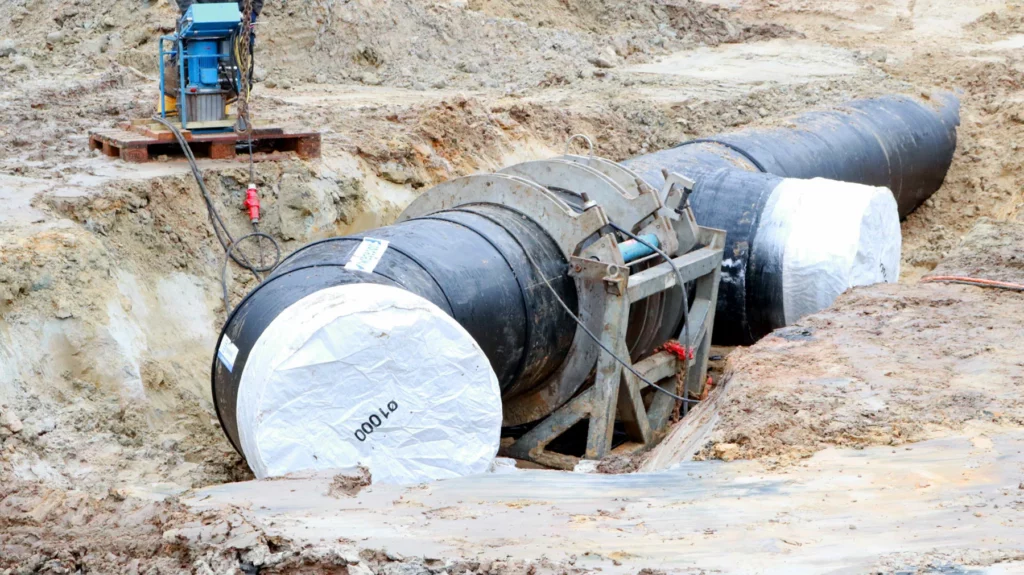
All buried pipelines were specified in durable and operationally reliable PE 100-RC. The egeplast egeXXL large-diameter pipe system was used in the diameter range up to 1,000 mm. A total of 350 m of pipes in SDR grade 17 were supplied. The segmented bends required for the numerous directional changes on the wastewater treatment plant site were also manufactured “to the exact degree” by egeplast. Butt welding was selected as the joining method for the PE 100-RC pipes and fittings. A corresponding butt-welding machine was provided from the egeplast rental fleet.
After the planned commissioning of the 4th treatment stage toward the end of 2019, scientific monitoring will continue for another year during the start-up phase. Based on these findings, the City of Greven expects final commissioning toward the end of 2020.
