



PIPELINE CONSTRUCTION Modern water management is undergoing a fundamental change; the focus is no longer solely on safe transport and supply, but also on the proactive protection of drinking water resources from external influences. Against the backdrop of climate change, new pollutant detections, and stricter regulatory requirements, infrastructure is transforming from a passive carrier to an integral component of risk management.
In addition to classic risks, new influencing factors are gaining increasing importance. These include climate-related changes, such as rising soil temperatures and longer residence times in the network, which can affect the microbiological stability of drinking water. At the same time, aspects of supply security and the protection of critical infrastructures (KRITIS) are moving more into focus, for example, with regard to external impacts from construction activities or targeted manipulations. Against this background, the need for extended status information that goes beyond classic selective measurement and testing procedures is increasing.
European and national framework conditions
With the revision of the EU Drinking Water Directive (RL 2020/2184) and its implementation in the TrinkwV (2023) and the Drinking Water Catchment Area Ordinance (TrinkwEGV, 2023), the regulatory focus is shifting: it is no longer just about compliance with individual parameters in random samples, but about systematic risk management along the entire chain from extraction to transport and delivery.
The requirements for risk assessment are becoming increasingly complex. In addition to considering individual substance parameters, a holistic assessment of the entire supply chain is moving into the foreground. This involves not only known hazards but also potential future risks, such as those from new pollutant sources or altered land use in the catchment area. The goal is to identify risks early and limit them through appropriate preventive measures.

Relevant Substance Parameters and Consequences for Infrastructure
The regulations introduce new, sometimes very low, limit values (e.g., sum of PFAS 0.1 μg/l). These limit values apply to the chemical composition of drinking water. For infrastructure, these requirements specifically mean: increased demands on material resistance, leak-tightness over the service life, and measurement and detection methods. Organic, mobilizable substances (BTEX, CHC) as well as persistent substance classes (PFAS) are particularly relevant. Therefore, systematic protection concepts are required in contaminated or potentially contaminated routes.
Drinking Water Protection Zones
Zoning (I–III) divides the protection areas for drinking water resources.
- Zone I (Catchment Area): Subject to the highest restrictions, as immediate endangerment of the extraction plant must be prevented here.
- Zone II (Inner Protection Zone): Also places particularly high demands on the infrastructure. Recognized codes of practice (e.g., DWA-A 142) require suitable measures for highly vulnerable routes, such as continuous leak monitoring and protection concepts to prevent infiltration.
- Zone III (Outer Protection Zone): Here, the measures primarily serve to protect against widespread or difficult-to-degrade chemical contamination.
For Design Engineers and operators, this means: where routes pass through Zone II, leak-monitored and verifiable solutions must be provided to prevent the release of pollutants into the soil (Fig. 2).

Consequences for Design Engineers and Operators
The new requirements shift the focus from a one-time acceptance test to ongoing integrity and risk assessment. Material selection, connection technology, testing concepts, and operational procedures must be considered during planning and firmly established in operations.
Classic sampling methods continue to provide the basis for compliance with quality requirements but only partially reflect temporal and spatial changes in the network. Supplementary status information can help to identify operational developments early and evaluate them specifically.
Climate-related changes and increased demands on the resilience of critical infrastructures mean that, in addition to classic quality parameters, operational influencing factors such as temperature developments or external impacts on the infrastructure are increasingly included in the consideration.
Material Science Fundamentals
The selection of suitable pipe materials is crucial for the safety, hygiene, and longevity of drinking water pipelines. Modern plastic pipe systems must meet technical, ecological, and economic requirements equally.
Material Selection and Basic Requirements
Stress crack resistant PE types such as PE100-RC are now standard for pressure pipelines in supply and disposal. Relevant material properties are:
- Hygienic and chemical advantages: Chemical inertness to drinking water and corrosion resistance (KTW-relevant).
- Longevity and flexibility: High stress crack resistance, longevity (50 years and more), and flexibility, which allows for high adaptability to ground movements.
- Ease of installation: Low weight and the possibility of delivery in long lengths reduce connection points and simplify installation.
Permeation and Barrier Requirements
Permeation describes the penetration of volatile or soluble substances through a polymer matrix. For highly vulnerable locations, which are contaminated by, for example, CHC or BTEX, the pure diffusion resistance of standard PE pipes is often not sufficient. Instead, multi-layer systems with a metallic barrier layer or other diffusion-inhibiting layers are used (Fig. 3). Such barrier systems prevent substance transport and are described as suitable measures in guidelines such as KIWA BRL 17101 to ensure drinking water quality.

Mechanical Integrity, Connections, and Workmanship Quality
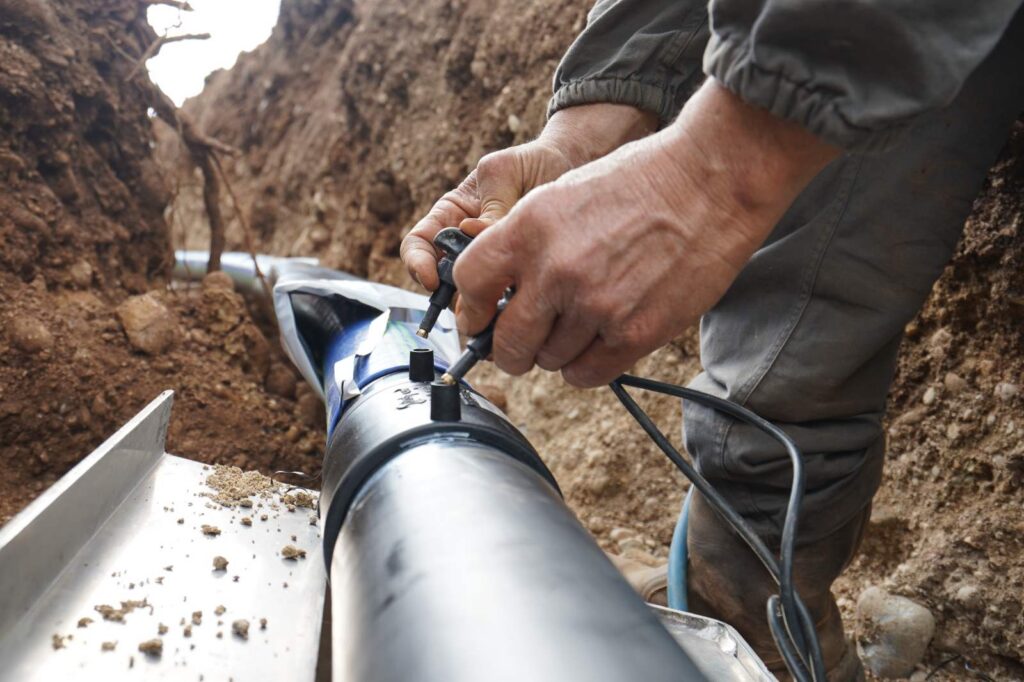
The mechanical tightness of a pipeline is the result of pipe material, fittings, and connection technology. Welded connections according to DVS guidelines (e.g., DVS 2207) are central, as errors in connection technology are one of the most common causes of leaks in practice. Workmanship quality is therefore a primary criterion for long-term network security.
Life Cycle Assessment and Contribution to Climate Friendliness
The protection of drinking water is closely linked to environmental protection. The life cycle assessment (LCA) of plastic pipes must be evaluated in the context of functional safety and the entire service life:
- Climate friendliness in the overall assessment: In the life cycle analysis, considering transport, longevity, and low maintenance intensity, PE pipes are considered more climate-friendly than many alternative materials.
- Resource conservation through tightness: The long-term tightness of plastic pipes leads to the avoidance of massive water losses and reduces the energy demand for water pumping and treatment.
- Economic advantages: Due to their low weight, they reduce transport emissions. In addition, they can be delivered in long lengths, which shortens construction times and minimizes connection points.
Technological Solutions
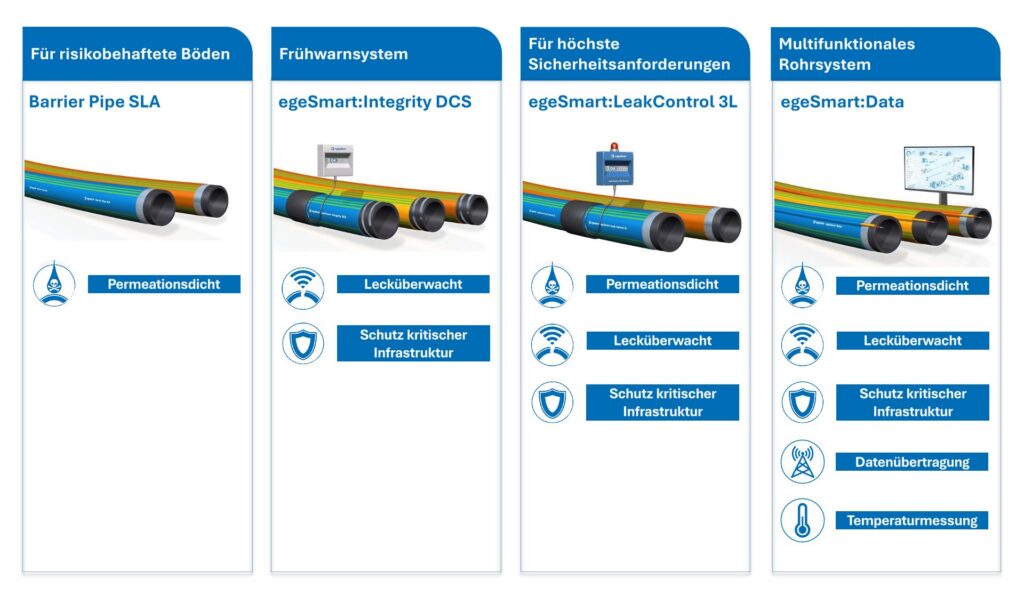
Modern plastic pipe systems offer functional intermediate layers to meet the stricter regulatory requirements (Fig. 4).
Passive Protection through Integrated Barrier Layer
Multi-layer pipes such as the Barrier Pipe SLA System combine the mechanical advantages of PE100-RC with a metallic barrier against organic pollutants. The system features an integrated, certified aluminum barrier layer that prevents permeation throughout the entire service life of the pipeline.
The selection of these systems is based on a hazard analysis (soil and groundwater samples) by the operator or the engineering firm. The testing strategy for long-term effectiveness must take into account the requirements of an internationally recognized testing guideline such as KIWA BRL 17101, which serves to ensure drinking water quality and is used as a basis for verification.
Active Protection through Monitoring
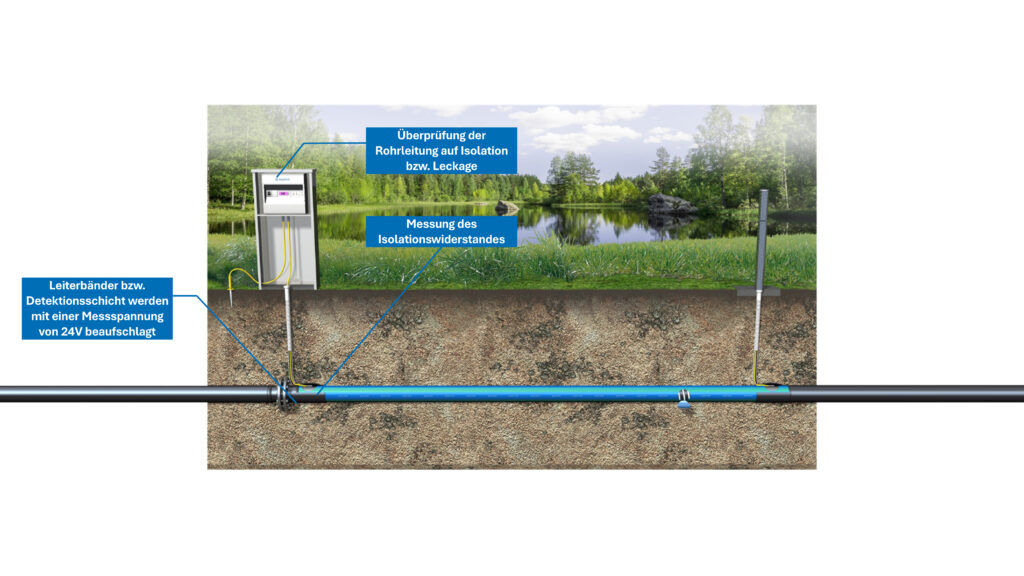
Monitored pipe systems enable continuous detection of leaks and allow for continuous condition assessment of the pipeline.
Technically proven concepts use electrically conductive intermediate layers or integrated conductor tapes. By applying a small voltage to the conductor and measuring the insulation resistance against the ground, the condition of the pipeline can be monitored. Such systems provide alarm messages and offer the possibility of precisely locating potential damage.
Examples of such monitoring systems include the egeSmart:Integrity DCS and the egeSmart:LeakControl 3L from egeplast. In the egeSmart:LeakControl 3L, the electrical conductor also serves as a permeation barrier layer, meaning the system meets the highest safety requirements. Such systems not only contribute to operational safety but also to hazard prevention: they detect leaks early and enable a quick response.
Beyond classic leak monitoring, modern systems are increasingly expanding their range of functions. These include, in particular, the recording of temperature profiles along the pipeline, the detection of external influences, and the provision of continuous status data for network operation. These developments are related to increasing demands on the resilience of critical infrastructures and the need to detect changes that are not immediately apparent at an early stage (Fig. 5).
Extended Condition Monitoring and Digitalization
Against the backdrop of increasing demands for transparency, verifiability, and risk-based network operation, the continuous, linear acquisition of status data is gaining increasing importance.
Fiber optic measurement systems (Distributed Temperature Sensing, DTS) form a technological basis for this. By coupling light signals into an optical fiber routed beneath the protective casing and evaluating the backscatter, the temperature can be continuously determined at any point along the fiber.
The resulting possibilities go beyond classic monitoring approaches:
- Continuous temperature profiles for identifying operational anomalies and potential microbiological risks
- Detection of external influences along the route
- Continuous status data as a basis for data-driven asset management
- Optional use as data infrastructure
- Direct and precise localization of damage events
An example of this technology is the innovative egeSmart:Data system from egeplast, which enables continuous monitoring of pipeline routes over long distances and can be integrated into existing control and evaluation systems
.
In contrast to selective measurement methods, such systems provide comprehensive status information that enables a new quality of network assessment and thus supports the transition to preventive, data-driven network operation.
Regulatory Alignment
The integration of specialized plastic pipe systems enables network operators and Design Engineers to comprehensively fulfill the risk-based approach of TrinkwV 2023 and TrinkwEGV (Tab. 1).

Conclusion and Outlook
The increased demands on drinking water protection require an integrated approach: material selection, structural measures, and continuous condition monitoring must be considered as a coherent system. Plastic pipe systems are evolving from a mere transport medium to active components of a risk-based infrastructure concept (Fig. 6 + 7).

Key Points for Practice
- Risk-based selection: The decision for pipes with a barrier layer or monitoring systems must be based on a thorough soil and hazard analysis.
- Combined protection concept: Passive barriers are
used where diffusion is relevant. Active
monitoring is used where leaks pose operational or regulatory risks (e.g., WSZ II). - Operational processes: Monitoring must be integrated into the alarm logic, escalation plans, and asset management to derive immediate courses of action from data.
Against the backdrop of climate change, increasing demands on the resilience of critical infrastructures, and growing regulatory requirements, the continuous acquisition of status data along the pipeline is gaining increasing importance. In particular, fiber optic measurement systems enable a previously unavailable level of transparency in network operation.
Thus, the infrastructure is prospectively developing into a data-driven, adaptive system that not only reacts to disruptions but also detects and limits their emergence early. Plastic pipes thus not only contribute to safe transport but also form the basis for a monitored, resilient, and future-proof drinking water supply.
References
[1] Federal Ministry of Health (BMG). (2023). Ordinance on the Quality of Water for Human Consumption (Drinking Water Ordinance – TrinkwV 2023). Federal Law Gazette 2023 I No. 159. Available at: https://www.gesetze-im-internet.de/trinkwv_2023/.
[2] Federal Ministry for the Environment, Nature Conservation, Nuclear Safety and Consumer Protection (BMUV). (2024). Ordinance on Catchment Areas of Abstraction Points for Drinking Water Production (Drinking Water Catchment Area Ordinance – TrinkwEGV). Federal Law Gazette 2024 No. 346.
[3] German Association for Water, Wastewater and Waste e. V. (DWA). (2024). Worksheet DWA-A 142: Wastewater pipes and sewers in water catchment areas. DWA, Hennef. Available at: https://de.dwa.de/de/regelwerk.html.
Source: Sustainability
